
I first became aware of this in my work as a consultant. During a discussion with a client, I realised I had had this same discussion before with other clients. I wondered why I kept ending up in the same situation and decided to investigate.
At the time, I had just started my first coaching programme. I asked my trainers to help me understand what might be going on.
Life scripts
The term ‘life script’ or ‘script’ refers to recurring patterns in our lives whose roots lie in the past. In other words, a life script is a particular set of thoughts and behaviours that causes us to keep having similar experiences. This can apply to both positive and negative experiences.
Most people do not realise how much they create their own reality in this way. Each of us has one or more scripts ‘installed’. These scripts influence how we experience the world around us — and therefore the choices we make. Because we are more likely to make certain choices, they also affect the outcomes and experiences that follow.
Scripts serve a purpose. They help us simplify the world around us. We do not have to invent a new response every time a familiar situation returns. In that sense, scripts make us more efficient.
The roots of a script
The foundation of a script is usually laid early in life. During childhood we discover how the world around us works. Because we are highly dependent on the people around us, much of our attention is directed towards our environment: especially parents or carers, brothers and sisters. Sometimes other people close to us — such as grandparents or teachers — also have a strong influence.
“My brother and I were both raised with the idea that it was important to behave well and in socially acceptable ways. I remember my grandparents rewarding me for a good school report. I received some money. My brother had a report with lower grades and promptly received much less than I did. Experiences like these shaped me into someone who made safe, rational and socially acceptable choices. By the time I was around thirty, that left me feeling stuck. Because I was used to making sensible and acceptable choices, I had never learned to connect with what I genuinely wanted — my inner compass. It was difficult to make choices that truly fitted me, and I was not clear about the direction I wanted my life to take.
Before I could make choices that were more aligned with who I am at a deeper level, I first had to become aware of my script. In my case, that script was about basing important decisions on other people’s opinions, standards and values.
My brother grew up in the same family and in much the same way. Yet he made a different decision. Early in life he chose to push back against the social standards around him and become self-reliant. He started his own business long before graduating. To this day he earns his living as an entrepreneur — successfully and in his own way.”
Why it matters to become aware of your script(s)
The concept of life scripts comes from Transactional Analysis, a school of psychology. Transactional Analysis assumes that our scripts contain personal beliefs about questions such as:
- How do I see myself?
- Will I succeed in the things that matter to me? And will I be satisfied with myself?
- How do I relate to others? And how do I position myself in groups?
Life scripts can strongly influence our personal and professional lives, now and in the future. If you notice that you keep getting stuck in the same kind of situation, there is a good chance that one or more scripts are active.
Once you are aware of the idea of a life script, you can begin to explore which scripts are active for you. You can even change a script — and therefore change the outcome of familiar situations.
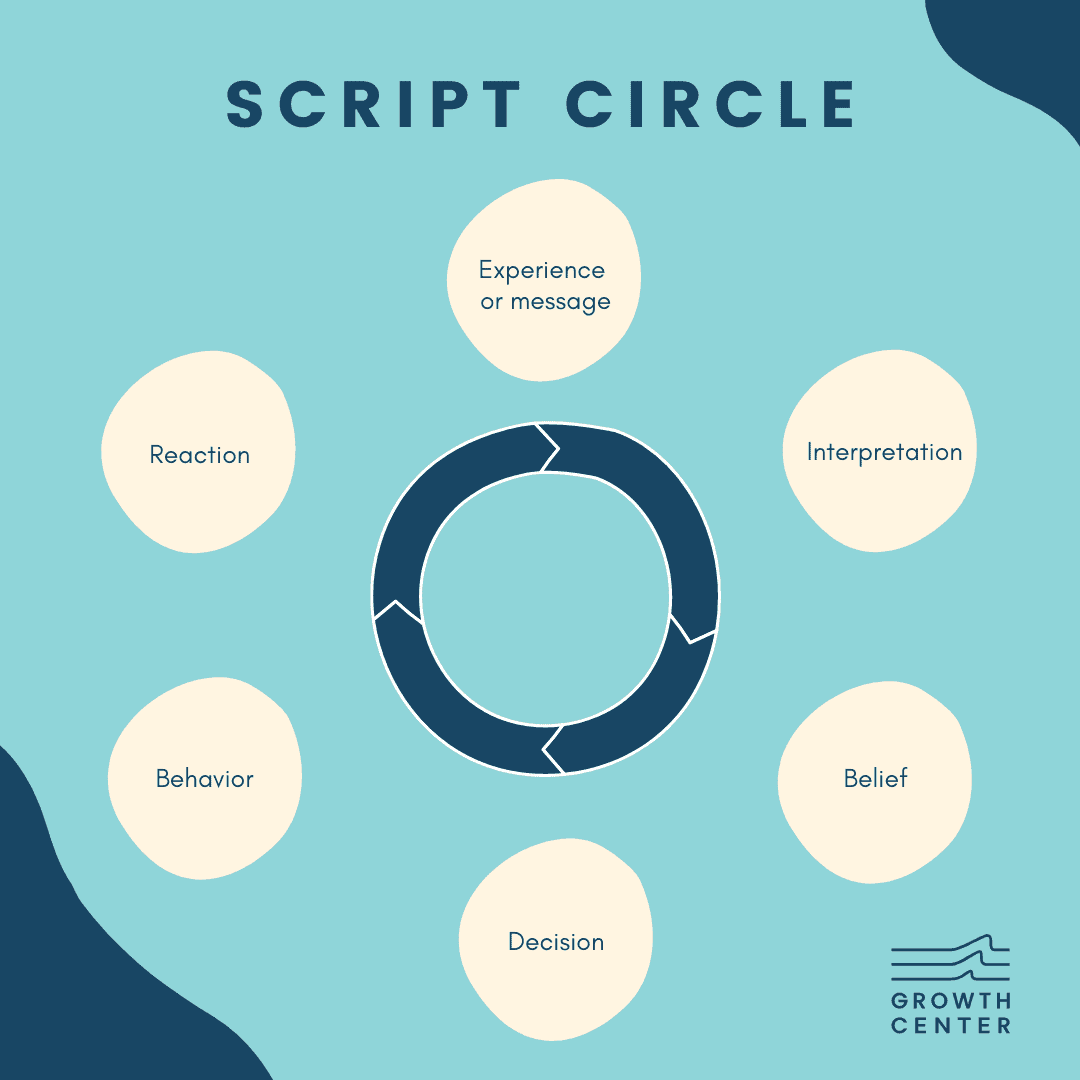
The script circle — working with your script(s)
A script can be tested and, where needed, adjusted. The ‘script circle’ is a practical tool for exploring your own scripts. Now that you know what a script is, you can start using the script circle. The instructions below will help you do that.
Do you recognise recurring patterns in your work or leadership? Through systemic coaching, you explore how your role and the relationships around you contribute to them.
Continue reading: read What does systemic work reveal? and How reliable is your self-image?.


